What To Look For In A Lease Or Rental Agreement
What to look for in a lease or rental agreement before signing in Ontario.
A lease or rental agreement is a binding legal contract in real estate. It requires both parties to honour their commitments and stick to every clause written in the document. However, since general knowledge around rental contracts is usually negligible, people routinely fail to read through them properly or understand what the fine print says. Failing to understand these terms can lead to severe financial penalties, unfair eviction threats, or lengthy legal battles.
At Toronto Boutique Apartments (TBA), we believe in complete transparency. Offering the best 1-, 2-, and 3-bedroom apartment rentals in the city, TBA has a track record of providing excellence for both long-term and short-term luxury stays. Whether you need a short-term corporate suite or a long-term home that keeps your housing costs predictable, understanding your rental paperwork is the first step to a stress-free tenancy.
This comprehensive guide covers everything you need to know about a lease or rental agreement, details what a rental agreement looks like, and reveals the high-stakes clauses you must verify before signing.
Rental Agreement vs. Lease - What is the Difference?
While many people use the terms interchangeably, they refer to different types of tenancy structures. Understanding this distinction is critical before reviewing the paperwork.
- A Lease Agreement - This is a fixed-term contract, typically spanning 12 months (though commercial leases can span multiyear terms). Under a fixed-term lease, neither the landlord nor the tenant can alter the terms or terminate the agreement early without mutual consent or specific legal cause.
- A Rental Agreement - This typically refers to a short-term or periodic arrangement, such as a month-to-month tenancy. The terms automatically renew at the end of each month unless either party provides proper written notice (usually 30 to 60 days, depending on local laws).
Visual Anatomy - What Does a Lease Agreement Look Like?
If you are entering the rental market for the first time, you might wonder - what does a lease agreement look like? Here is what a Residential Tenancy Agreement (Standard Form of Lease) looks like:
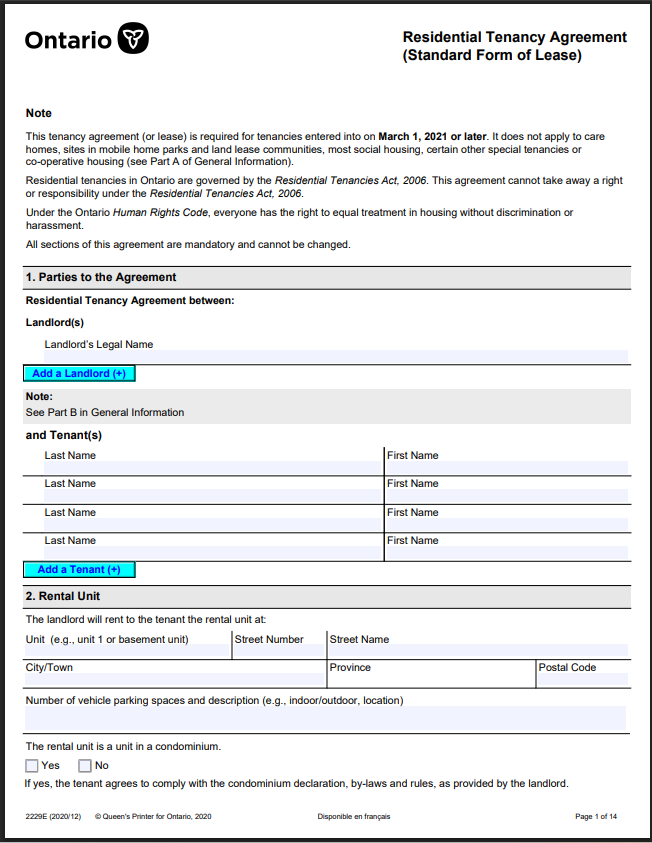
Visually, a modern residential lease is a structured, multi-page document divided into numbered sections or sections with checkboxes. Rather than a wall of dense legal prose, modern jurisdictions rely on standardized templates. For example, if you are renting an apartment in Ontario, your agreement should look exactly like the Ontario Standard Lease form issued by the Ministry of Municipal Affairs and Housing.
The Structural Flow of a Standard Rental Contract
A standard lease document generally follows this logical sequence:
Lease Section
Component Focus
Key Elements to Verify
Section 1
Parties & Contact Info
Legal names of landlords/tenants and official notice addresses.
Section 2
Premises Description
Exact unit number, parking stall numbers, and locker assignments.
Section 3
Key Dates & Renewals
Tenancy start date, end date, and month-to-month transition rules.
Section 4
Financial Core
Total base rent, exact due date, and approved payment channels.
Section 5
Deposit Framework
Last month's rent deposit value and strict local limits.
The Core Financials - Beyond the Base Rent
The most common mistake tenants make is looking only at the baseline monthly rent figure. To protect your bank account, look for these specific financial items:
Base Rent, Due Dates, and Payment Methods
The lease must explicitly state your exact monthly rent and the calendar day it is due (typically the 1st of the month). It should also outline acceptable payment methods, such as Interac e-Transfer, direct deposit, or post-dated checks.
Note that in many progressive jurisdictions like Ontario, a landlord cannot legally require you to provide post-dated checks or automatic pre-authorized debits as a mandatory condition of the lease. They can request them, but forcing them into the contract is an unenforceable clause.
Deposits and Pre-Payments
A standard lease will detail the exact amount required for deposits. Review these numbers carefully to ensure they match local regulatory limits:
- Residential Limits - In Ontario, a landlord can only request a rent deposit equal to one month’s rent (often used as the last month's rent). They cannot legally demand a damage deposit separate from this rent deposit.
- Commercial Differences - If you are signing a commercial lease, these strict consumer protections do not apply. Commercial security deposits can equal multiple months of rent and are subject to negotiation.
The Utilities and Amenities Matrix
Never assume what all-inclusive means. Your lease must include a clear breakdown, often using a checklist format, specifying which utilities are included in the base rent and which ones are billed separately.
Utility / Service
Landlord Pays
Tenant Pays
Key Inspection Point
Electricity (Hydro)
Checkbox
Checkbox
Is the unit sub-metered individually?
Water & Sewage
Checkbox
Checkbox
Is it bundled into condo fees or billed separately?
Gas / Heating
Checkbox
Checkbox
What type of heating system powers the unit?
Internet / Cable
Checkbox
Checkbox
Is there a mandatory bulk internet agreement in the building?
Parking & Storage
Checkbox
Checkbox
Are space numbers explicitly listed in the contract?
Tenancy Duration, Transitions, and The Automatic Conversion Myth
The Length or Term of the Lease section establishes the timeline for your residency. It specifies the exact start date (your move-in day) and the termination date of the initial period.
However, what happens after that termination date is a frequent source of tenant anxiety and landlord misinformation. Many tenants believe that when a 12-month lease ends, they must either sign a new year-long lease or move out.
The Month-to-Month Shift
In Ontario and various tenant-friendly jurisdictions, fixed-term residential leases automatically convert to a month-to-month tenancy under the exact same terms once the original period ends. You are not required to sign an extension or a new contract to stay in your home. The landlord cannot evict you simply because the calendar year has ended; they can only end the tenancy under specific, legally mandated conditions (such as personal use eviction via proper regulatory channels).
Conversely, a commercial lease is more cut-and-dried. It will typically expire completely at the end of the term unless a specific Option to Renew clause was negotiated and executed within the designated timeframe.
Rules, Restrictions, and Illegal Clauses You Must Spot

Landlords often try to insert customized addenda or rules into a rental agreement to limit tenant activity. As a tenant, you must know things about a lease or rental agreement, including recognizing which written clauses are actually completely void under local laws.
The Pet Policy Reality Check
Many lease templates contain a clause stating No pets allowed inside the premises. However, if you are renting an apartment in Toronto, Ontario, Section 14 of the Residential Tenancies Act (RTA) explicitly states that a no pet clause in a lease is void and unenforceable.
Even if you sign a lease containing this clause, you cannot be evicted simply for having a pet. The only exceptions are if the property is a condominium with strict corporate bylaws banning animals, or if the animal causes severe allergic reactions, property damage, or safety hazards to other residents.
Smoking and Cultivation
Unlike pet bans, smoking bans are 100% legal and enforceable. A landlord has the right to preserve the structural integrity and indoor air quality of their investment. Look for explicit terms banning smoking or vaping tobacco, cannabis, or other substances within the unit or on private balconies.
Guests, Roommates, and Subletting
Review the rules regarding long-term guests. While landlords cannot prohibit you from having occasional overnight guests or a relationship partner stay over, they can insert clauses regarding permanent, undocumented occupants who are not listed as tenants on the property paperwork.
If you plan to travel or need to move out before your fixed term ends, check the terms for subletting or assignment:
- Subletting - You move out temporarily, and a subtenant moves in, but you remain fully responsible for the lease and rent payments.
- Assignment - You hand over the lease permanently to a new tenant, completely severing your financial relationship with the landlord.
- By law, a landlord cannot unreasonably or arbitrarily withhold consent for an assignment or sublet request.
Maintenance, Repairs, and the Boundary of Wear and Tear
A common point of friction during a tenancy is determining who pays for property issues. A well-drafted rental agreement will clearly define maintenance boundaries.
Landlord Maintenance Obligations
The landlord is legally obligated to maintain the rental property in a good state of repair, fit for habitation, and in compliance with all health, safety, and housing standards. This applies to major structural components, plumbing, electrical wiring, heating, and major appliances supplied with the unit (refrigerator, stove, washer/dryer).
Tenant Upkeep Obligations
Tenants are responsible for ordinary cleanliness and repairing damage caused by their own willful misconduct or negligence (or that of their guests).
Critical Distinction - Wear and Tear vs. Damage
- Normal Wear and Tear - Faded paint, worn carpets in high-traffic hallways, small scuff marks on baseboards, or a loose cabinet hinge from daily use. The landlord covers these costs.
- Property Damage - A cracked windowpane, deep gouges in hardwood floors from dragging heavy furniture, or a clogged drain caused by pouring grease down the kitchen sink. The tenant covers these costs.
Alterations and Changing It Back
Are you planning to paint an accent wall or hang a flat-screen TV? Look for clauses concerning alterations. Most agreements state that you must obtain written permission from the landlord before making structural modifications or painting. If approved, you may be required to paint the walls back to their original neutral colour before vacating the unit.
Landlord's Right of Entry - Protecting Your Privacy
A lease agreement does not grant a landlord free rein to walk into your home whenever they please. Your rental agreement must outline clear boundaries regarding the landlord’s right of entry, which is strictly governed by regional legislation to protect tenant privacy.
Except in the case of a direct emergency (such as a bursting water pipe or a fire), a landlord must provide you with at least 24 hours of written notice before entering your apartment. This notice must specify:
- The exact date of entry.
- A reasonable window of time (e.g., between 9:00 AM and 5:00 PM).
- A valid reason for entry (such as performing a structural inspection, carrying out required repairs, or showing the unit to potential renters or buyers if your lease is ending).
Identifying and Protecting Vulnerable Co-Signers
If you are a student, an international newcomer, or a freelancer without a conventional employment history, a landlord might ask for a guarantor or co-signer. This individual signs the agreement alongside you, legally binding themselves to cover your rent payments if you default.
What to Look for in Co-Signer Terms:
Ensure the lease isolates the co-signer’s financial liability strictly to rent defaults. It should clearly outline how and when their liability terminates, particularly if the initial fixed term transitions into a standard month-to-month arrangement.
Never Rely on Verbal Promises - The Four Corners Rule

In contract law, there is a concept known as the Four Corners Rule or the parol evidence rule. It means that if a dispute goes before a judge or a tenancy tribunal, only the terms written within the four corners of the final signed document matter.
If a landlord tells you during an open house, Oh, don't worry, I will repaint this bedroom before you move in, or The storage locker down the hall is included in your rent, but those items are missing from the formal lease document, they do not legally exist.
Before signing, ensure every verbal promise is added directly into the agreement as an official amendment or appendix.
Experience the Gold Standard in Toronto Rentals
Navigating the nuances of local tenant laws can feel overwhelming, but it becomes simple when you partner with transparent, professional housing providers. Whether you are searching for premium temporary housing or an elegant long-term base in Ontario's capital, our team ensures your rental paperwork is simple, clear, and perfectly compliant with all local housing frameworks.
Explore our collection of fully managed, beautifully curated spaces and find your next premium home at Toronto Boutique Apartments. Contact us today!
Key Takeaway Checklist for Future Renters
Before your pen touches the paper on your next rental journey, walk through this quick scannable verification checklist:
- Are all legal names and the complete unit address (including unit/apartment number) completely accurate?
- Does the rental figure match what was advertised, and is the due date clear?
- Is there an explicit list of included utilities rather than a vague verbal promise?
- Is the deposit structure compliant with local caps (e.g., no illegal damage deposits)?
- Are any illegal terms, such as complete pet bans or mandatory post-dated checks, present?
- Does the lease match standard governmental formats, like thehttps://www.ontario.ca/page/guide-ontarios-standard-leaseOntario Standard Lease template?
- Are all repair commitments and appliance inclusions written directly into the contract text?
For more comprehensive information about tenant safety guidelines, regional rental trends, or national housing standards across Canada, you can consult resources provided by the Canada Mortgage and Housing Corporation (CMHC) or check out regional landlord-tenant advisory platforms like the Landlord and Tenant Board.
Frequently Asked Questions (FAQs)
1. Can a landlord change the rules or increase the rent in the middle of a lease?
No. Once a fixed-term lease is signed, the rent amount and the core terms of the agreement are locked for the duration of that term (e.g., 12 months). Any changes require mutual written consent. In Ontario, rent can generally only be increased once every 12 months, and the landlord must provide at least 90 days' written notice using the official regulatory form, even after the lease converts to a month-to-month tenancy.
2. What happens if I need to break my lease early?
Breaking a fixed-term lease early can carry financial penalties unless done through legally approved channels. If you must leave, your best options are to ask the landlord for written permission to terminate the lease early, or to find a qualified new tenant to take over your apartment through subletting (temporary) or assignment (permanent). By law, landlords cannot unreasonably refuse a qualified candidate.
3. Is an online or digital signature legally binding on a rental contract?
Yes. Modern digital signatures generated through verified platforms (such as DocuSign, Adobe Sign, or official provincial portals) are entirely legal and binding for residential and commercial leases. Before signing digitally, ensure you have downloaded a complete, unedited copy of the agreement for your personal records.
4. Who is responsible for replacing lightbulbs, smoke detector batteries, or air filters?
While major structural maintenance falls entirely on the landlord, standard day-to-day upkeep is typically the tenant's responsibility. Minor tasks, such as replacing burnt-out lightbulbs within your unit, replacing smoke detector batteries, or keeping the space reasonably clean, are standard tenant obligations under the umbrella of ordinary cleanliness.
5. What should I do if a clause in my lease goes against local tenant laws?
Suppose a landlord inserts a clause into your rental contract that violates local housing laws (such as banning overnight guests or demanding an illegal damage deposit). That specific clause is automatically null, void, and unenforceable, even if you signed the agreement. The rest of your lease remains completely valid, but the illegal rule cannot be legally weaponized against you.
Furnished monthly rentals Toronto · Search availability · View this page